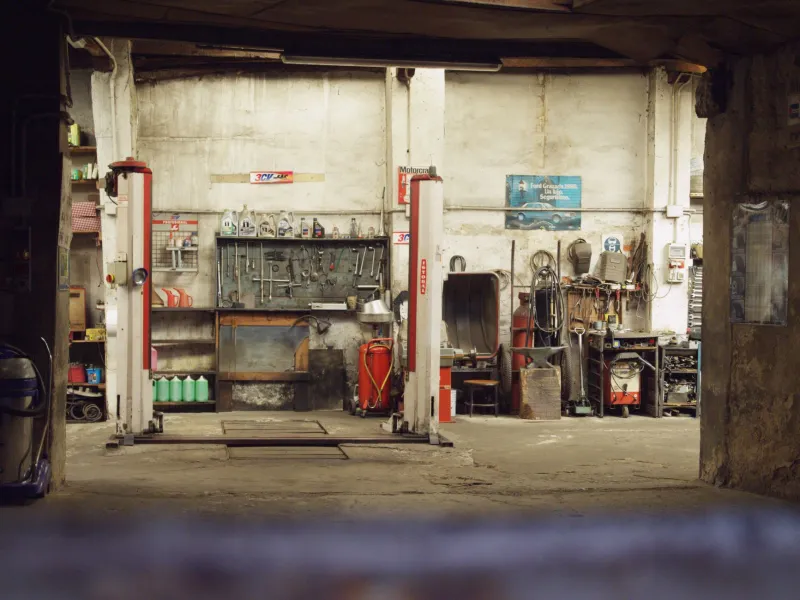
Fifty Quid Well Spent: Nine Garage Safety Checks to Run Before Any Job

Photo: home garage axle stands trolley jack wheel chocks safety, via www.qcnews.com
There's a pattern to how home garages fill up. The tools get bought with enthusiasm — the shiny socket set, the impact driver, the trolley jack that was on offer. The boring stuff never gets bought at all. No chocks. An extinguisher still in its cardboard sleeve from three Christmases ago. A work lamp with a scorch mark on the cable.
None of that matters until the afternoon it does. And the annoying truth is that a methodical lap of your garage with about fifty pounds in your pocket will do more for your safety than any tool you could add to the collection.
Start with the kit that holds the car in the air
1. The jack. Pump it up empty and watch it. A trolley jack that sinks slowly, weeps oil round the ram or has a saddle that rocks is not a jack any more — it's a lever with ambitions. Check the capacity against your car's kerb weight (there's a plate on the jack, usually underneath), make sure the release valve turns smoothly and the handle clip still holds. And be honest about the scissor jack in the boot: that's for a puncture on a hard shoulder, not for a Sunday service on a sloping drive.
2. Axle stands. These are the ones doing the actual work. Look for cracks at the welds, a bent leg, a missing locking pin, a ratchet bar that drops under load. Check the rating stamped on the side. Stands should sit on a flat, solid surface — not gravel, not block paving that's sinking at the edges, and not a bit of plywood you've been meaning to replace. Locate them under the manufacturer's jacking points or the subframe, never under a sill seam that's already crumbly.
3. Wheel chocks. Cheapest safety item in the building and the most frequently skipped. Most UK driveways slope towards the road for drainage, which means the car is quietly trying to roll away from you the whole time. A pair of rubber wedges costs under a tenner, or cut two offcuts of 4x2. Chock the wheels that stay on the ground, both directions if the slope is meaningful.
Then the things that keep you breathing
4. Ventilation. Carbon monoxide has no smell, no colour and no sense of timing. Never run an engine in a closed garage to 'just warm it up', not even for two minutes. Door open, and if you're doing anything that involves idling, a fan pushing air through the space.
5. Fire extinguisher. A 1kg dry powder or 2kg CO2 unit costs £15–25 and should live near the exit — not at the far end of the garage behind the fuel cans, which is where they always end up. Check the pressure gauge, give powder extinguishers a shake and a turn upside down once a year so the contents don't cake solid, and replace anything past its service date rather than trusting it.
6. Battery charging. Smart chargers have made this much less frightening, but the basics still apply: ventilate the space, because charging gives off hydrogen; connect the clamps before switching on and switch off before disconnecting; never charge a battery that's frozen, hot or leaking; and plug the charger into an RCD-protected socket. A plug-in RCD adaptor is under a tenner and belongs in every garage.
And the dull storage jobs nobody photographs
7. Oils and solvents. Original labelled containers, lids done up, nothing decanted into an old squash bottle. Keep them off the floor if you can, well away from the boiler, the pilot light and anything that sparks, and stand them in a cheap drip tray so a split bottle doesn't become a contamination problem. Then there's the rag issue — oil- and solvent-soaked rags can heat up on their own in a pile. Keep them in a lidded metal tin and bin them regularly rather than leaving a mound of them in the corner.
8. Light and leads. Halogen work lamps get hot enough to melt a coolant hose or a cable, and they fall over. An LED work light is £10–15, runs cool and is brighter anyway. Route extension leads overhead or along hooks rather than across a wet floor, coil them properly, and bin any cable with a nick in the sheath.
9. You. Phone charged and within reach. Somebody in the house knows you're out there and roughly how long you'll be. Safety glasses and nitrile gloves within grabbing distance. No rings, no loose sleeves, no hoodie strings near a spinning thing. And if you can possibly help it, don't work under a car on your own.
The fifty-quid tally
Assuming the jack and stands are already yours and in decent order, the rest comes in comfortably under budget: chocks £8–10, extinguisher £15–20, RCD adaptor £8, drip tray £5, LED lamp £10. That's about £50 for a garage that behaves itself.
If your stands are questionable, that's the one place worth going over budget. A pair rated for your car is £30–40 and it's the single most important purchase in the whole list.
The ten-minute walk-round
Do it this weekend, before the next job rather than during it. Stand in the doorway and look at the garage as a stranger would: what's on the floor, what's leaning against what, what would fall if you caught it with your shoulder, what you'd reach for first if something caught fire.
Nine checks, one lap, half a morning's spend. It's the cheapest upgrade your workshop will ever get.