Stain Spotting: A Field Guide to the Puddles Under Your Car
Park a car on the same patch of tarmac for a fortnight and it starts leaving you notes. Not in words, obviously — in smears, drips and the occasional small rainbow. Learning to read them is one of the cheapest diagnostic skills a driver can pick up, and it costs nothing beyond a torch and a few sheets of kitchen roll.
This isn't about turning yourself into a backyard mechanic. It's about knowing which puddles are just weather, which are air conditioning doing exactly what it should, and which are the car quietly suggesting you book it in before something costly lets go at 70mph on the M6.
Rule out the boring explanations first
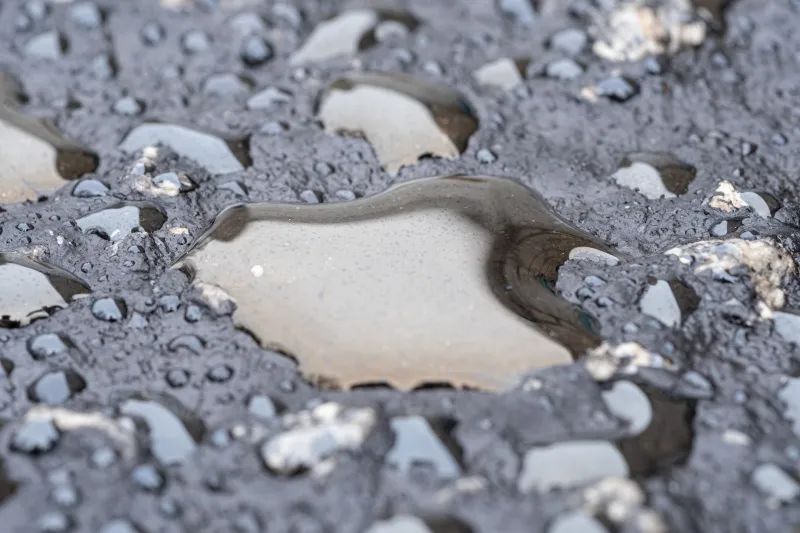
Before you panic, remember what November does to a UK driveway. Weeks of rain, wet leaves clogging gullies, and a car that sheds water from every mirror housing, door seal, boot lid and sunroof drain for hours after the sky clears. Weather water is clear, has no smell and vanishes without leaving a mark.
The other regular innocent party is air conditioning. If you've had the climate control on — demisting counts — you'll often find a clear puddle roughly under the front passenger footwell or centre of the car. That's condensate. It's supposed to be there. What is not supposed to be there is anything pink, orange or sweet-smelling in that spot.
Colour and texture do most of the work
Get down on one knee with a torch rather than lying underneath anything. Then look at two things: what it looks like, and where it sits relative to the car.
- Engine oil. Fresh stuff is amber, used stuff is black, and it feels slick rather than watery. It doesn't evaporate. A couple of spots under the middle of the engine bay between services can be a weeping sump plug or a tired rocker cover gasket; a patch that doubles in a week is a different conversation.
- Coolant. Bright pink, orange, green or blue depending on what's in there, watery to the touch, faintly sweet, and it dries into a chalky, slightly tacky crust. Usually up front, below the radiator or expansion bottle.
- Brake fluid. Pale yellow to amber, thinner than engine oil, and it will happily take the paint off your driveway if you leave it. Found near a wheel or under the bulkhead. Never one to monitor and forget.
- Screenwash. Blue, pink, green, sometimes yellow, and unmistakable on the nose — it smells strongly of its own label. Expect it near the front bumper.
- Gearbox and transmission fluid. Red or amber, oily, generally near the centre of the car. Red automatic transmission fluid is a loud signal, not a quiet one.
- Diesel and petrol. Diesel is oily yellow-brown and leaves a smell that follows you around for the rest of the day. Petrol evaporates almost as you watch it. Either one near the tank or under the rear seats deserves attention.
- Grease. Black, sticky splatter sprayed around the inside of a wheel arch usually means a split CV boot has been flinging its contents about.
Smell, but do it sensibly
A cautious waft from a distance is fine. Sniffing around a hot engine bay or a fresh spill is not, and tasting anything is a hard no — old-fashioned coolant contains ethylene glycol and is genuinely toxic, quite apart from being unpleasant.
The drips that mean 'garage, today'
A few categories don't belong in the wait-and-see pile:
- Brake fluid of any quantity, anywhere.
- Red transmission fluid.
- Coolant loss alongside a temperature gauge that's climbing, a heater that's gone cold, or steam.
- Anything that smells of fuel inside the cabin.
- An oil patch that's bigger than a 50p coin overnight and growing.
- Fluid running down the inside of a tyre or wheel.
For the rest — a light film, an old stain, a single spot after a long motorway run — note it, date it and check again in a week. MOT testers will flag excessive leaks, but a slow weep won't necessarily fail anything, so the driveway is often the first place you'll hear about it.
Investigating without becoming a cautionary tale
You don't need to get under the car, and you shouldn't unless you've got proper stands in place. Instead:
- Slide a flattened cardboard box under the car overnight, mark which end is the front, and weight it down with a brick.
- Park in the same spot, facing the same direction, so you can compare like with like.
- Check the engine bay too: white crusty residue round hose joints, a damp undertray, a coolant bottle that keeps dropping below the minimum line.
- Photograph whatever you find with your phone, and jot the date in the notes app.
That leak diary is worth more than you'd think. Turning up at a garage able to say "red fluid, nearside front, first noticed three weeks ago, roughly a teaspoon a night" gets you a far more useful conversation than "there's a puddle" — and often saves a diagnostic charge.
When in doubt, spend the phone call
Drips are information, not verdicts. Most of what appears on a driveway is condensation, screenwash overspill or a tired gasket that can wait for payday. But the moment the fluid is red, brake-scented, fuel-scented or growing, stop reading and start ringing. A ten-minute check now is considerably cheaper than a breakdown on a wet Monday morning in 2027.